
Smart Monitoring Tips
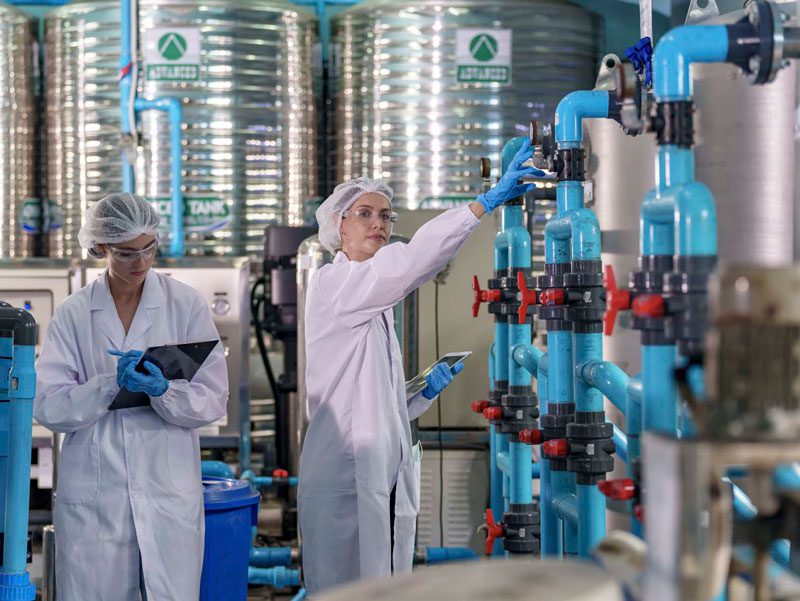
The Foundation: Water’s Role and HACCP
Before implementing smart technology, you must understand your water’s specific uses and hazards under your Hazard Analysis Critical Control Point (HACCP) plan.
- Hazard Analysis: Water can introduce biological (pathogens, biofilm), chemical (heavy metals, cleaning residues), and physical (suspended solids) hazards.
- Critical Control Points (CCPs): Identify every point where water quality is critical to food safety. This often includes the facility’s intake point, where water becomes an ingredient (e.g., blending tanks), final product rinse or wash stations, and recirculated water loops.
- Critical Limits: Define the precise, measurable limits (e.g., residual chlorine level, turbidity, pH) that must be met at each CCP.
Smart Monitoring: Key Technologies and Parameters
Smart monitoring uses sensors, data loggers, and cloud-based analytics to give you 24/7 visibility into your water quality and usage, turning data into actionable alerts.
Continuous Quality Parameter Monitoring
Instead of relying solely on periodic lab testing, smart systems monitor critical parameters in real-time using in-line sensors:
- pH Level: Continuously monitored with pH Probes at key process points. This is important because pH indicates acidity/alkalinity, which affects pathogen growth, corrosion, and the effectiveness of chemical treatments like chlorine.
- Temperature: Tracked with Thermal Sensors integrated into pipes and tanks. Temperature is critical for legionella control, process control (e.g., pasteurization), and chemical efficacy.
- Conductivity (TDS): Measured with Conductivity Cells. High conductivity indicates Total Dissolved Solids, which can signal excessive mineral buildup (scale) or residual chemicals.
- Turbidity: Monitored using Turbidity Meters. High turbidity (cloudiness from suspended particles) can shield microbes from disinfectants, so clarity is key.
- Disinfectant Residual: Tracked using Specific Ion or Oxidation-Reduction Potential (ORP) Sensors. This ensures the water remains properly sanitized throughout the distribution system by verifying real-time dosing (e.g., Free Chlorine or Ozone levels).
Usage and Flow Monitoring
IoT-enabled flow meters and pressure sensors offer invaluable data for both compliance and cost savings.
- Real-Time Flow Meters: Place sub-meters at key high-usage areas. Sudden spikes or drops in flow when equipment is off can instantly indicate a significant leak or unauthorized use.
- Pressure Monitoring: Maintaining consistent pressure is vital for effective spraying/rinsing and preventing system backflow or cross-contamination. Pressure sensors can instantly alert operators to deviations.
- Automated Leak Detection: By comparing inflow volume with measured consumption, smart systems use predictive algorithms to pinpoint leaks in the distribution network, saving water, energy, and preventing facility damage.
Smart Monitoring Tips for Implementation
1. Integrate Monitoring into Your CCPs
Embed the smart sensors directly into your water system’s CCPs. The sensor’s critical limits should match your HACCP Critical Limits. When a sensor reading deviates (e.g., residual chlorine drops below 0.5 ppm), the system must instantly trigger a Corrective Action alert.
2. Focus on Biofilm Control
Biofilm (a layer of microorganisms encased in a protective matrix) is the single greatest threat in food facility water systems.
- Target ORP: Use ORP (Oxidation-Reduction Potential) sensors alongside your disinfectant residual monitors. ORP is a better indicator of water’s sanitizing power than just chemical concentration. Aim for a consistently high ORP level (e.g., over $650 \text{ mV}$) to actively inhibit biofilm growth.
- Monitor Dead Legs and Low-Flow Areas: Schedule periodic, targeted sampling in these high-risk areas, even if your smart sensors are on the main line.
3. Leverage Predictive Analytics and Cloud Storage
Don’t just collect data, use it to predict problems.
- Trend Analysis: Cloud platforms can analyze historical data to identify long-term trends like gradually rising conductivity or falling disinfectant efficacy. These subtle shifts can indicate a filter nearing failure or increasing scale buildup before it violates a critical limit.
- Automated Reporting: The system should automatically generate reports required for regulatory compliance and internal auditing, providing a verifiable record of continuous control at all water CCPs.
4. Continuous Calibration and Verification
Smart sensors are only as good as their calibration.
- Scheduled Calibration: Implement a strict schedule for sensor calibration against certified standards.
- Verification: Routine manual sampling and external lab analysis are still necessary to verify that the automated system is working correctly. This verification process is a critical part of your HACCP validation procedure.
By adopting these smart monitoring strategies, food production facilities can shift from a reactive, corrective maintenance model to a proactive, preventative approach, safeguarding product integrity and operational efficiency simultaneously.